Singapore Itinerary Planning: Where Self-Planning Actually Saves Money
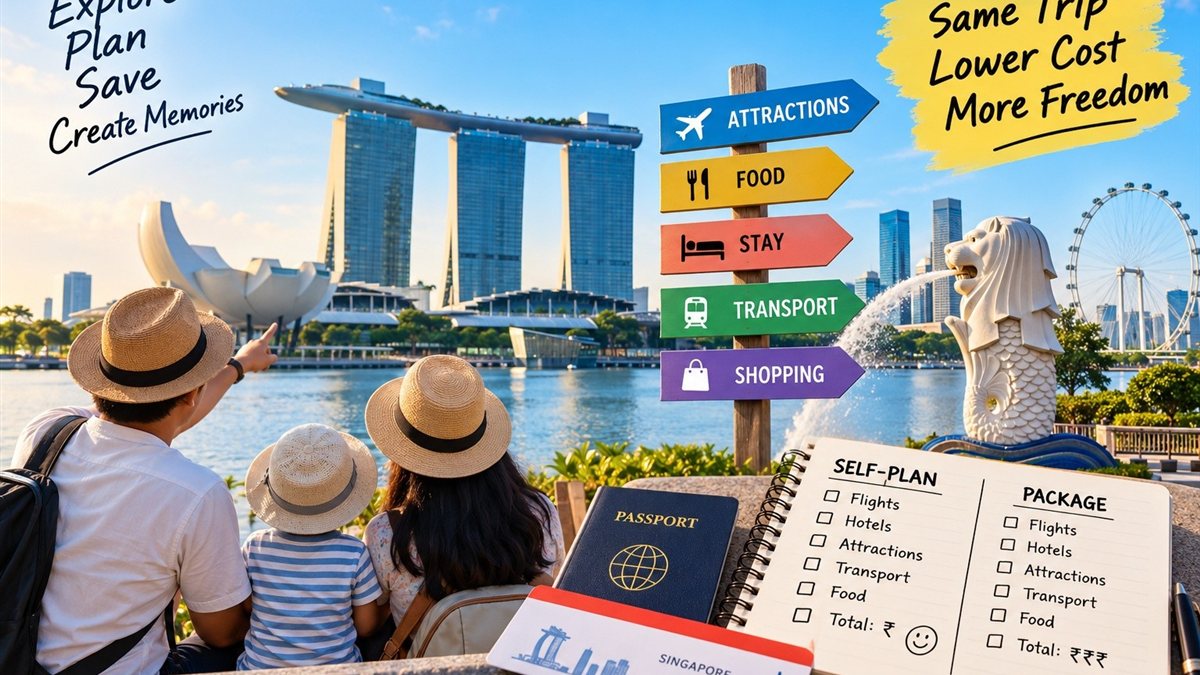
We planned this Singapore itinerary the way we plan every trip on this blog: check the real prices first, then work out the points in the itinerary where a traveler either saves money or overpays without noticing. No travel agency, OTA, or tour operator is named below. This is about the underlying math, not who to book through.
The frame is a family of 4 (2 adults, 2 kids) on a realistic 5-day, 4-night Singapore trip. Prices are in SGD with a rough INR conversion at roughly ₹75 per SGD (mid-September 2026). That rate moves week to week, so treat every INR figure here as an approximation, not a quote.
The self-plan vs. package math, upfront
Advertised Singapore package tours from India commonly list “starting from” prices in the ₹19,000 to ₹32,000 per person range for a 4N/5D land package. Two things worth knowing before treating that number as the real cost.
First, “starting from” is a floor, not a quote. These figures are usually twin-sharing, exclude international flights, and often exclude entry tickets to the attractions you actually came for (Universal Studios, Night Safari, Gardens by the Bay). By the time flights, entries, and a few paid add-ons are in, a genuinely comparable all-inclusive package for a family of 4 typically lands well above the headline number. We won’t put a precise figure on that gap, since it depends heavily on season, hotel category, and which extras get bundled.
Second, the margin gets built into things you can buy yourself for less. A package’s attraction entries are usually bought in bulk by the operator and marked up when resold to you as part of the bundle. Buying the same combo tickets directly (Gardens by the Bay’s own combo, Mandai’s own Zoo + Night Safari pass, Skyline Luge’s own multi-ride combo) gets the same entry for less, because you skip paying for someone else’s bulk-buy margin, itinerary planning, or bus and guide overhead you don’t need in a small, walkable, English-signed city.
A package does earn its cost in a few specific cases: a fixed multi-city Malaysia-Singapore combo, a guided food and culture walking tour with real local expertise, or simply zero interest in planning anything yourself. Those are legitimate reasons to pay for one. It’s a different trade than “cheaper,” and worth being honest with yourself about which one you’re actually buying.
Before you fly: what to sort out first
None of this changes the itinerary, but skipping it is how a well-planned Singapore trip gets a stressful start.
Visa. Indian passport holders need a visa to enter Singapore — there’s no visa-on-arrival and no visa-free entry, so this has to be sorted before you fly, not at Changi. Applications go through an ICA-authorised agent, strategic partner, or Singapore contact via the SAVE e-Service, carry a S$30 government processing fee, and are usually processed within three working days. Apply within 30 days of your travel dates, and check your passport has at least six months’ validity from your entry date — that’s a hard requirement at immigration, not a suggestion.
SG Arrival Card. Separate from the visa, every traveller has to submit the SG Arrival Card online, with a health declaration, within three days of arrival. It’s free to file yourself through the SGAC e-Service or the MyICA app, so there’s no reason to pay anyone to do this for you.
Attraction tickets. If you’re using any of the combo passes further down this itinerary, buy them online before you land rather than at the gate. Online pricing is usually the cheaper of the two, and it skips a queue on the day.
Payments. Carry an international debit or credit card and check its foreign transaction markup before you travel — it adds up more than people expect over five days of taps and swipes (our travel credit card comparison covers this if you’re choosing a card for the trip). Singapore is card- and contactless-heavy, but it’s still worth carrying some Singapore dollars in cash for hawker stalls and smaller vendors that don’t always take cards. Avoid converting cash in small batches; the exchange spread tends to be worse each time you do it.
SIM or eSIM. You’ll want data from the moment you land, for maps, ride-hailing, and checking ticket QR codes, so sort a local SIM or eSIM before you leave rather than joining the airport counter queue. We’re not naming a specific provider or price here since both change often — compare a couple of options against your actual data needs for five days.
Power adapter. Singapore uses the three-pin Type G plug, which isn’t what Indian sockets use, so pack an adapter rather than assume your charger will fit.
Insurance and documents. Basic travel insurance is worth having for a trip this length. Save a copy of your passport, visa approval, insurance policy, and hotel bookings somewhere offline too — a downloaded PDF, not just an email you’ll need signal to open.
What to carry
Water. Singapore’s tap water is safe to drink straight from the tap, treated to meet WHO drinking-water standards, according to PUB, the national water agency. Carry a refillable bottle instead of buying bottled water every couple of hours. It’s a small habit, but it adds up over five hot days with two kids asking for a drink at every stop.
Weather. Singapore is hot, humid, and gets sudden downpours without much warning. A compact umbrella, sunscreen, and comfortable walking shoes are worth packing regardless of what the forecast says the week you travel — here’s something we wish more first-time travellers planned for, rather than getting caught out on Day 2 at Sentosa. Don’t make every single day fully outdoor either; keep one indoor option (a mall, an aquarium, a museum) available in case a day turns into a washout.
A small medicine kit. Pack whatever you’d normally carry: basic personal medicines, any prescriptions, a few plasters, and anything child-specific your family actually uses. This isn’t medical advice, just a reminder not to assume you’ll easily find your usual brands on day two of a trip.
If you’re travelling with a toddler. A stroller, with a rain cover, earns its keep across a trip with this much walking. Pack diapers, wipes, snacks, a spare set of clothes, and sunscreen in the day bag rather than the suitcase. Build nap or rest time into the schedule instead of treating it as lost time, and leave more buffer than you think you need for MRT transfers with a stroller and a tired toddler. A cheaper itinerary isn’t much of a win if the family is exhausted by 4pm — keep at least part of each day flexible enough to cut short.
Below is the self-planned itinerary, with each money decision flagged where it happens.
Day 1: Arrival, Marina Bay, Gardens by the Bay
Land, check in, and keep this half-day light. Jet lag and immigration queues eat more time than people budget for. If your room isn’t ready yet, most hotels will hold bags at check-in for free — confirm this with your specific hotel rather than paying for a locker or an extra transport leg just to avoid carrying luggage for a few hours.
Decision point: airport transfer. A metered taxi or ride-hail car from Changi to a Marina Bay or Orchard-area hotel typically runs SGD 28-42 (higher after 10pm surcharges or in heavy traffic and rain, when ride-hail pricing can jump to SGD 50-60 on a normally-SGD-30 route). The MRT from Changi Airport station into the city costs a few dollars a head. For a family of 4 with luggage after a long flight, one shared private ride is usually the right call anyway. The MRT “savings” tend to get eaten by dragging bags through interchange stairs. This is one of the few legs where paying for the cab is the sensible choice.
Evening at Gardens by the Bay. The Cloud Forest plus Flower Dome combo ticket runs roughly SGD 46-48 for adults and SGD 28 for children. Buying the two conservatories separately (around SGD 28 each) costs more for barely any extra flexibility, so the combo is the right default. The Supertree Observatory Skyway is a separate add-on at roughly SGD 14; skip it unless the kids are keen, since the free Supertree Grove light show at night covers most of the “wow” for nothing.
Decision point: dinner. A hawker centre meal (Satay by the Bay, right next to the Gardens) runs roughly SGD 8-15 per person for a full plate. A sit-down restaurant nearby for the same meal easily runs two to three times that per head. For a family of 4, that’s the difference between a roughly SGD 40 dinner and a SGD 100-plus one, on night one alone.
Day 2: Sentosa, Universal Studios or beach plus Skyline Luge
Pick one anchor activity, not both, and don’t try to also fit Sentosa’s beaches and the Luge and the aquarium into the same day. Sentosa days that try to do everything end up rushed and cranky by 4pm.
Decision point: USS vs. beach day. Universal Studios Singapore tickets run roughly SGD 83-89 for adults and SGD 62-69 for children (higher on weekends and peak dates, cheaper booked online in advance than at the gate). For a family of 4 that’s roughly SGD 300-320, or about ₹22,500-24,000 at the reference rate. A beach day plus Skyline Luge instead costs a fraction of that: Luge multi-ride combos run roughly SGD 25-35 per person depending on how many rides you bundle, and Palawan and Siloso beaches are free. If the kids are young enough that USS’s bigger rides are wasted on them, the beach and Luge day is the better spend, not just the cheaper one.
Decision point: getting to Sentosa. The Sentosa Express monorail and the walk-in via Vivocity are both cheap, a few dollars or free depending on entry point. A private cab across the causeway adds cost for no real time saved on this route, so save the cab budget for later in the trip.
Decision point: Skyline Luge combo size. Buy the 3- or 4-ride combo upfront rather than single rides one at a time. The per-ride cost drops as the combo size goes up, and kids will ask to go again regardless.
Day 3: Chinatown, Little India, Kampong Glam
A cultural neighborhood day is naturally the cheapest day of the trip if you let it be, because the draw is walking and eating rather than ticketed entries.
Decision point: transport between neighborhoods. These three areas sit on or near the same MRT line, roughly 5-15 minutes apart by train depending on the exact stations and interchange. Even a day like this, with five or six short hops (hotel to Chinatown, Chinatown to Little India, Little India to Kampong Glam, back to hotel), usually still comes out cheaper on single-ride fares than a Tourist Pass, because the pass is priced per person and short hops are individually inexpensive. Tapping in with a physical EZ-Link or NETS FlashPay card, or a tap-to-pay bank card (Singapore’s transit system accepts both), keeps you on the cheaper option by default. The pass only wins if one person is individually racking up a genuinely high trip count in a single day, so add up your planned trips per traveler before buying one rather than assuming it always helps.
Decision point: food. This is hawker centre territory almost by design. Maxwell Food Centre, Tekka Centre, and the Kampong Glam stalls are exactly what most people picture when they picture Singaporean food, and a family of 4 can eat well for roughly SGD 40-50 total across a meal here, against two to three times that at a sit-down restaurant covering the same neighborhoods.
Skip the guided walking tour add-on that most packages bundle for this day unless you specifically want the historical narration. A free self-guided route using any map app covers the same ground, and the neighborhoods are safe and easy to navigate without a guide.
Day 4: Singapore Zoo or Night Safari
Pick a day plan and don’t try to cram both the Zoo and Night Safari into one day with two kids. The Zoo runs daytime hours and Night Safari starts at dusk, so doing both back to back makes for a very long day for young children.
Decision point: combo vs. single ticket. A standalone Night Safari ticket runs roughly SGD 58 for adults and SGD 41 for children. Mandai sells multi-park passes bundling combinations of the Zoo, Night Safari, River Wonders, and Bird Paradise; a two- or three-park pass typically runs somewhere in the SGD 90-140 range for adults depending on which parks are included, meaningfully cheaper than buying the same parks separately. Check the current park lineup and pricing on Mandai’s own site before booking, since bundle composition and prices both shift. If there’s any chance you’ll want more than one Mandai park, buy the combo pass on day one of the trip rather than deciding park by park.
Decision point: getting to Mandai. This is genuinely outside easy MRT range for a family with tired kids, especially returning from Night Safari late in the evening. This is the other leg, besides the airport run, where a private cab or ride-hail is worth the money over public transport. A free shuttle bus from the nearest MRT exists but adds real time with young kids at 9 or 10pm.
Decision point: food at Mandai. Options inside the wildlife parks are priced like most attraction-adjacent dining, higher than a hawker centre and roughly comparable to a casual restaurant. If it fits your schedule, eating before you go or after you’re back keeps this day’s food cost close to a normal meal rather than a theme-park markup.
Day 5: Orchard Road flex or shopping day
Keep this day loose. It’s your buffer for anything that ran long earlier in the trip, and it doubles as the shopping day most families want anyway.
Decision point: shopping vs. one more attraction. If the trip has run smoothly, this is a free day: walk Orchard Road, let the kids pick a mall with air conditioning and a play area, and treat any spending as shopping budget rather than itinerary cost. If a decision point from an earlier day got skipped, say the Gardens by the Bay Skyway or a second Luge session, this is the day to slot it in rather than adding a rushed extra stop earlier in the week.
If you do shop enough to notice it, check whether you qualify for Singapore’s GST tourist refund. Eligible tourists (16 or older, not Singapore citizens or residents) can claim a refund on purchases of at least SGD 100 from participating retailers, claimed via the eTRS kiosks at Changi or Seletar airport when you depart, per IRAS. It won’t make or break the trip, but it’s money you’re already entitled to, and easy to forget in the rush of a departure day.
Decision point: last transport leg. For the return to the airport, the same private-cab-for-a-family-of-4 logic from Day 1 applies. This is a case where the small premium over the MRT is worth it for a stress-free departure with luggage. If your flight is later in the day, ask about a late checkout or bag storage rather than dragging suitcases around Orchard Road all afternoon.
Small expenses that quietly add up
The itinerary above covers the big, plannable decisions. The real leaks are usually smaller and easy to wave off individually: a bottled drink here, a taxi because it’s raining, an impulse snack, a last-minute ticket bought at the gate instead of online, a second SIM top-up because the first one ran out, a forex conversion done twice instead of once. None of these are big on their own. Add them up across five days for a family of four and they can rival one of the bigger decisions in this itinerary. The habit worth building isn’t “spend less,” it’s “notice the total” — that’s usually where a self-planned trip’s savings quietly leak back out.
Where the totals land
Putting rough numbers on the self-planned attraction and transport decisions above, excluding flights and hotel since those vary too much by season and category to generalize:
| Category | Decisions made well | Decisions made carelessly |
|---|---|---|
| Attraction tickets | Lower, using combo pricing across Gardens, Mandai, and Luge | Meaningfully higher if every ticket is bought separately |
| Local transport | MRT or shared rides for short hops, private cab only for the airport and the Mandai night leg | Higher if a private cab is used for every hop |
| Food | Hawker-centre-heavy, restaurant dining only occasionally | Two to three times higher if most meals are at restaurants |
The exact rupee gap depends on your dates and choices, so we’re deliberately not inventing a single headline “you’ll save ₹X” number. The honest takeaway is that the decision points matter more than the destination. The same 5-day Singapore trip can cost noticeably different amounts for two families doing the identical itinerary, depending on whether combo tickets got used, whether the MRT got used for the easy legs, and whether meals leaned hawker or restaurant.
A few caveats before you plan around this
These numbers won’t hold up on their own without a couple of honest caveats.
Prices move. Attraction ticket prices, MRT fares, and the SGD-INR rate all change through the year. Treat every figure above as a “roughly” or “typical” range to plan against, and check current prices before booking.
Combo pass value depends on your actual plan. The Tourist Pass math on Day 3 is a real example of a savings product that doesn’t automatically save money: it’s priced per person and only wins past a certain number of daily trips for that individual. Do that arithmetic for your own itinerary rather than assuming any pass is a default win.
This is trip-cost arithmetic, not investment or tax advice. For the India-specific side of paying for a Singapore trip, forex cards, credit card forex markup, LRS limits, that’s a separate topic from itinerary planning, and worth checking against current RBI and bank rules close to when you book, since those do change.
The price ranges cited above are cross-checked against current 2026 listings from Sentosa and Universal Studios Singapore’s own site, Gardens by the Bay’s official ticketing page, Mandai Wildlife Reserve’s official pricing, Skyline Luge Singapore’s official pricing page, SimplyGo and the Singapore Tourist Pass’s own site, and general ride-hailing and taxi fare-tracking sources for the Changi routes. Reconfirm the numbers close to your travel dates regardless.
Related posts

Jio vs Airtel vs Vi: Are You Paying for Netflix or Prime Twice Through Your Recharge?
Jio, Airtel, and Vi postpaid plans now bundle Netflix, Prime, and JioHotstar. Check if your recharge already covers what you pay for separately.

Diaper Subscriptions in India: Do They Actually Save Money?
Whether subscribing to diapers on Amazon or other platforms actually saves money in India, and how much the discount is really worth over a year.

NAN Pro and Baby Formula: Subscription vs Bulk Buying, What Actually Costs Less
Comparing subscription discounts against bulk buying for NAN Pro and other baby formula in India, and which one actually works out cheaper.